This activity engages the students in folding a circle or a paper plate to learning the xy-coordinates and the radian measure for 16 angle measures. A recent revision has added pictures to the directions to help the students through the folding steps.
https://www.teacherspayteachers.com/Product/Folding-a-Unit-Circle-988661
My blog is dedicated to providing secondary teachers with classroom materials that engage students in discovering mathematical concepts. The materials I sell in my store "Math Through Discovery" on Teachers Pay Teachers are based upon 47 years of teaching grades 7 though college. All activities have been used in a mathematics classroom.
Sunday, September 1, 2019
Tuesday, July 30, 2019
Jet Tour of Calculus - Five Days of Lessons - Bundled
This is a Jet Tour of the 5 main topics students will learn about in AP Calculus or Calculus:
1. Instantaneous Rate of Change
2. Behavior of a Function
3. Definite Integrals
4. Using Formulas to find Definite Integrals
5. Limits
Each lesson is designed to use the graphing calculator to building understanding for the five topics graphically, numerically, analytically, and verbally. Each lesson is designed to be completed in one regular class period of 40-50 minutes.
A two question assignment is also included.
Answers to all activities are included.
This is a great way to begin a study of calculus.
Monday, July 29, 2019
Students can used their graphing calculators to build an understanding for the formal definition of a derivative (limit as h approaches zero of (f(x+h)-f(x))/h). Students will set up the forward difference quotient, the backward difference quotient, and the symmetric difference quotient approaching the same limit. Then students will let h equal 1, 0.1, 0.01, and 0.001) to notice that all the difference quotients approach one function.
The function they are all approaching will be called the derivative of the original function.
This is a great activity to use with the students prior to working analytically with the students to find the derivative of many basic functions. It gives the students a visual picture of what is happening to the difference quotients as h approaches zero.
Students can use this activity to develop all the basic derivative rules that they will need to memorize in Calculus.
This activity sheet, containing 20 questions, has the
students working with the sum of the angles in a polygon, sum of the exterior angles in a polygon, and the measure of a single angle in a regular polygon.
The students will
- develop the rule for the sum of the angles in a polygon;
- find the number of sides given the total degree measure of the interior angles;
- explain why a polygon cannot have a certain total number of
degrees; - solve for a missing angle in a polygon;
- find the measure of one angle in a regular polygon; and
- solve for interior and/or exterior angles
on a polygon.
Answers are included for all exercises.
Sunday, July 28, 2019

You can use each activity sheet as the foundation for one of your lessons.
The 32 activity sheet include these smaller bundles. Each activity sheet and each bundle can be purchased separately.
Each of these activity sheets can be bought separately in my store by clicking on each individual title.
There are also smaller bundles of activities named A Bundle of Activity Sheets for Calculus - 1, 2, 3, and 4.
Thursday, March 7, 2019
Are you wondering how to teach Calculus students are slope fields?
Are you wondering what a slope field is?
Are you looking for some classroom materials to use to teach slope fields?
Does your textbook lack much information on slope fields?
Then you will probably want to check out this bundle or any of the seven individual products included in the bundle.
https://www.teacherspayteachers.com/Product/Slope-Field-Bundle-3145676
Many new teachers and experienced teachers are looking for ideas for teaching the concept of multiplying monomials and binomials or factoring polynomials. I have created 12 lessons on these concepts. Each lesson includes an explanation of the technique being studied and a set of problems for the students to complete based upon the explanation. The idea presented in the explanation could become part of the teacher's presentation of the topic. Or the teacher can hand the explanation to the students and have them study it explanation on their own. Each lesson comes with a complete set of answers.
The rectangular box method is used to complete the multiplication of binomials. After students become comfortable with multiplying binomials, students are challenged with trying to find two binomials that multiply together to make a trinomial. Students are encourage to try to use the rectangular box method in reverse. As students work with the rectangular box they discover that they need to take the middle term of the trinomial and split it into two monomials. Students look for four greatest common factors and then confirm that the two binomials they have found do multiply together to make the trinomial.
These 12 lessons can be purchased separately or at a reduced price at a bundle.
The rectangular box method is used to complete the multiplication of binomials. After students become comfortable with multiplying binomials, students are challenged with trying to find two binomials that multiply together to make a trinomial. Students are encourage to try to use the rectangular box method in reverse. As students work with the rectangular box they discover that they need to take the middle term of the trinomial and split it into two monomials. Students look for four greatest common factors and then confirm that the two binomials they have found do multiply together to make the trinomial.
These 12 lessons can be purchased separately or at a reduced price at a bundle.
The 12 lessons are
1.Multiplying Monomials
2.Multiplying Monomials and Binomials
3.Multiplying General Binomials with Leading Coefficients of 1
4.Multiplying Binomials with Leading Coefficients of 1
5.Looking for Patterns When Multiplying Binomials with Leading Coefficients of 1
6.Multiplying Binomials with Leading Coefficients Not Equal to 1
7.Multiplying Special Binomials
8.Practice Multiplying Binomials
9.Reverse Multiplying (Factoring) Polynomials with Leading Coefficients of 1
10. Reverse Multiplying (Factoring) Polynomials with Leading Coefficients Other than 1
11. Factoring by Grouping
12. Factoring into Monomials and Binomials
https://www.teacherspayteachers.com/Product/12-Bundled-Lessons-on-Multiplying-and-Factoring-2463600
Wednesday, October 10, 2018
Thursday, October 4, 2018
Almost every day I add additional Activity Sheets for Algebra to my store Math-Through-Discovery-Llc.
These activity sheets can be used as the basis of a lesson, a homework assignment, or a worksheet. Each sheet usually has 20 exercises. Each Activity Sheet comes with a full set of solutions.
Three of the latest Activity Sheets include
These activity sheets can be used as the basis of a lesson, a homework assignment, or a worksheet. Each sheet usually has 20 exercises. Each Activity Sheet comes with a full set of solutions.
Three of the latest Activity Sheets include
Sunday, September 16, 2018
The three forms for a linear equation are described: Standard form, Slope-Intercept form, and Point-Slope form. But all three approaches emphasize the same point: let's locate two points so we know where the line is.
- We can do it through replacing x with zero and y with zero and solving for two points
- We can do it through making an x-y table to find two points
- We can do it through the y-intercept and using slope to find a second point
All three forms are approached with the same strategy of locating two points on the line. Once two points are located, the position of the line is determined.
This activity sheet has three sets of questions:
· Given an equation, locate the graph of the line on a coordinate axis. Students are not instructed as to which method they should use. The general strategy is to use any method to find two points that are solutions to the equation.
· Given four equations and four graphs, students must match which graph corresponds with which graph.
· Given an equation and a point, students must describe if the point is a solution to the equation two different ways: by graphing and by substitution.
Solutions for all exercises are included.
Activity-Sheet-on-Graphing-Linear-Equations
Wednesday, September 12, 2018
This activity sheet, containing 20 exercises, focuses on solving equations that have variables on both sides of the equation. It should follow lessons where students have solved one-step, two-step, and multi-step equations.
The activity sheet begins with some guidelines for students to follow as the approach this new type of equations.
• Students are recommended to perform all distributive properties so each side on the equation only has terms that are either variables or constants.
• If the equations only have terms that contain variables or constants begin by trying to collect the variables on one side and the constants on the other side.
• Most students find it easier to work with an equation by avoiding negatives. Although this isn’t totally possible, we can minimize the number of negative signs by moving the term that represents the small of two quantities.
• Students are reminded that when solving more complex equations they may run into an equation where no solutions are possible or all solutions are possible.
To help the students understand each guideline, examples are included for each recommendation.
The activity sheet has
• Twelve exercises that resemble those in the guidelines,
• Six slightly more challenged equations with variables on both sides of the equation,
• One geometry-related problem where students have to write and solve their own equation with variables on both sides of the equation, and
• One challenging problem that deals with variables on both sides of the equal sign.
A set of solutions for all exercises is included.
Activity-Sheet-on-Solving-Equations-with-Variables-on-Both-Sides
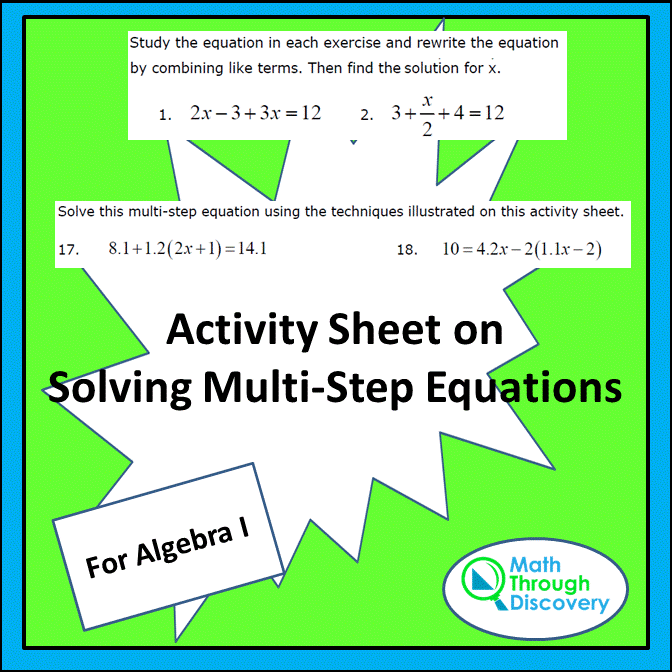
The activity sheet contains 20 questions that can be used as the basis of a lesson or for a classwork or homework sheet on solving multi-step equations.
The emphasis is to use the distributive property and/or combine like terms to simplify the equation to a two-step equations of the form ax+b =c.
The activity sheet has
• four equations where students combine like terms first,
• four problems where they use the distributive property first,
• four equations where they will use a reciprocal to simplify the equation,
• three equations where they can choose their method of solving,
• one exercise where they must discover where the error was made by a student in solving a multi-step equation,
• two more challenging multi-step equations to solve, and
• two exercises where students write an multi-step equation for a perimeter problem.
A complete set of solutions is included
Activity-Sheet-on-Solving-Multi-Step-Equations
Subscribe to:
Posts (Atom)